
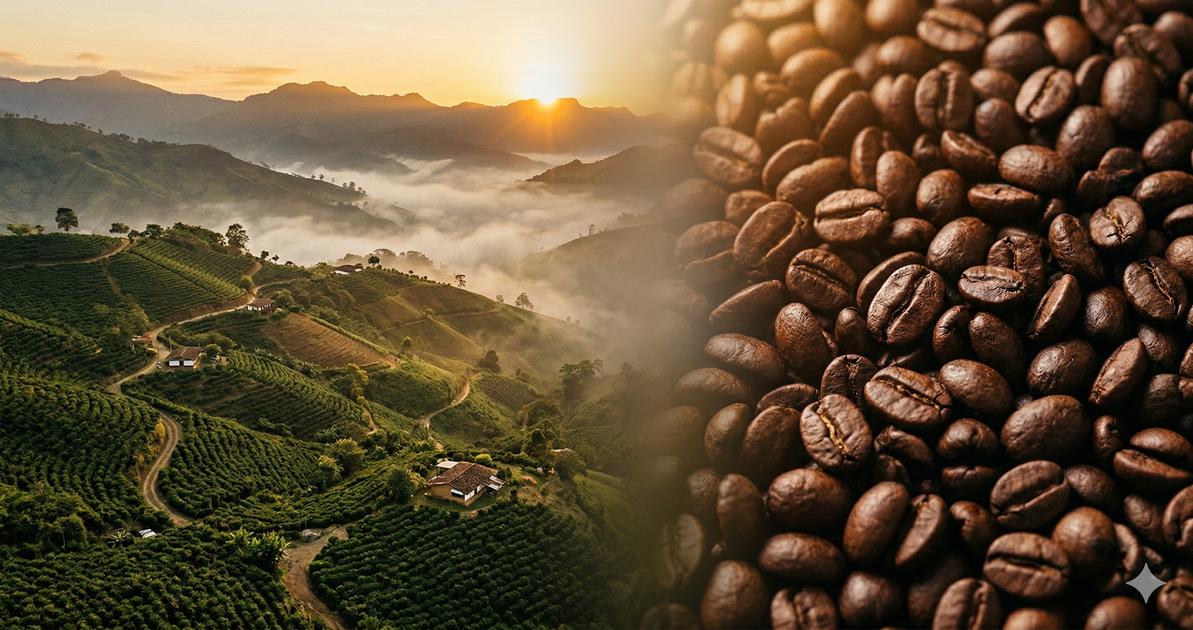
If you’ve ever wondered why Colombian coffee commands premium prices at specialty cafés, the answer isn’t marketing hype. It’s soil, altitude, and 200 years of tradition. Let’s dig in.
Geography & Altitude: The Foundation
Colombia is one of only a handful of countries where coffee grows at the ideal altitude for exceptional flavor. Most Colombian coffee is grown between 1,400 and 2,000 meters above sea level—the “sweet spot” for specialty coffee.
Why altitude matters:
- Slower ripening: Higher altitude = cooler temperatures = beans develop slowly and densely
- More complex flavors: Dense beans have more sugars and aromatics
- Higher acidity: That brightness and clarity specialty coffee lovers crave
Sabor de Montaña is grown at 1,400–1,800m in Huila, where volcanic soil adds mineral complexity to the cup. Compare this to:
- Brazilian coffee (often 800–1,200m): Smoother, less acidic
- Ethiopian coffee (often 1,500–2,300m): Very bright, floral
- Nicaraguan coffee (often 1,200–1,600m): Balanced, medium body
Colombia’s geography is Goldilocks: high enough for complexity, not so extreme that flavor becomes thin.
The Three Coffee Regions of Colombia
Huila (Southwest)
- Altitude: 1,400–1,800m
- Climate: Tropical highland, consistent rain
- Flavor Profile: Balanced sweetness (panela, caramel), chocolate body
- Grade: High Excelso production
This is where our Sabor de Montaña grows. Huila is renowned for clean, sweet coffees with low defects.
Coffee Triangle (Central: Caldas, Risaralda, Quindío)
- Altitude: 1,200–1,700m
- Flavor Profile: Fruity, floral, chocolate, medium body
- Production: Coffee tourism hub; some of the best small farms
Cauca & Nariño (Southwest, Higher)
- Altitude: 1,600–2,100m
- Flavor Profile: Bright, complex, stone fruit, high acidity
- Production: Smaller volume, experimental varieties
Each region produces distinct coffees. Colombia’s diversity is unmatched globally.
The Coffee Plant & Variety Matters
Bourbon vs. Typica vs. Colombia
Most Colombian coffee comes from three main plant varieties:
Typica: Ancient variety, excellent flavor but low yields (15–25 plants per hectare)
Bourbon: Mutation of Typica, better yields, consistent quality (40–80 plants per hectare)
Colombia: Hybrid developed specifically for Colombian conditions—rust-resistant, drought-tolerant, high-yielding
Sabor de Montaña is typically a Bourbon/Colombia blend—the best of both worlds. Bourbons bring complexity; Colombia genetics ensure hardy, disease-resistant plants.
Altitude & Density: The Excelso Grade
Colombian coffee is graded by bean size (sieve size):
- Excelso: Beans 15–16.5mm (premium, small but dense)
- Supremo: Beans 16.5–18mm (larger, can be less dense)
Here’s the secret: Smaller, denser beans at high altitude often taste better than large beans from low altitude. This is why Excelso commands a 20–30% premium.
Smaller beans = more surface area per bean, which means better extraction in your cup. You taste the difference immediately.
Processing: Washed vs. Natural
Most Colombian coffee is washed processed (like Sabor de Montaña):
- Berries harvested
- Skin, pulp, and mucilage removed by water/friction
- Beans fermented 12–24 hours in tanks (develops flavors)
- Washed clean and dried in sun or mechanical dryers
- Milled to remove parchment layer
Result: Clean, bright, fruit-forward cup with clarity. You taste the bean’s origin clearly.
Natural/dry processing (less common in Colombia) produces earthier, fruitier profiles—popular in Ethiopia and Brazil, less in Colombia.
The washed process is labor-intensive and requires clean water, but it’s why Colombian coffee tastes crisp and sweet.
The Harvest: Hand-Picked Ripeness
Colombian coffee farmers hand-pick nearly 100% of their harvest. This is radically different from large operations in other countries that machine-harvest entire branches.
Hand-picking means:
- Only ripe cherries: Farmers pick cherry-by-cherry when fully ripe (dark red)
- Multiple passes: Same plants harvested 3–5 times per season
- Zero unripe beans: Unripe beans taste green/vegetal—hand-picking eliminates this
This labor-intensive approach costs more but produces cleaner, more consistent cups.
The Microclimates Advantage
Colombia’s geography creates dozens of distinct microclimates. Two farms 20km apart can produce noticeably different coffees due to:
- Rainfall patterns
- Sun exposure
- Soil composition
- Elevation shifts
- Local wind patterns
This diversity is a strength. Farmers experiment, learn, and compete on quality. Unlike monoculture regions (some parts of Brazil), Colombian coffee thrives on this complexity.
Tradition & Knowledge
Colombian coffee farming isn’t a factory—it’s a craft passed through generations.
Many Huila farmers learned from their parents and grandparents. They know:
- Exactly when to prune their plants
- Which fermentation times create the best flavors
- How to adapt to climate shifts
- Which trees produce the sweetest cherries
This isn’t taught in textbooks. It’s embedded in the soil and hands of families who’ve been doing this for 100+ years.
Economic Model: Fair Pricing
Here’s where it gets political. Colombian coffee farmers have historically been underpaid—global commodity prices set in New York and London don’t reflect the real cost of production.
By sourcing directly and paying fairly (€50/kg wholesale, which translates to $2–3/kg paid to farmers vs. $0.80/kg for commodity coffee), we ensure:
- Farmers invest in quality improvements
- Young people stay on farms instead of migrating to cities
- Sustainable practices get rewarded
- Communities thrive, not just survive
This is why Colombian specialty coffee matters beyond just taste.
How Colombia Compares Globally
| Region | Altitude | Flavor | Grade | Typical Price |
|---|---|---|---|---|
| Colombia (Huila) | 1,400–1,800m | Balanced, sweet, chocolate | Excelso | Premium |
| Ethiopia | 1,500–2,300m | Floral, fruity, bright | Washed | Premium |
| Kenya | 1,400–1,800m | Berry, wine-like, complex | AA | Premium+ |
| Brazil | 800–1,200m | Smooth, nutty, low acid | Cup quality | Mid-range |
| Indonesia | 1,200–1,600m | Earthy, herbal, full body | Grade 1 | Mid-range |
| Costa Rica | 1,200–1,800m | Balanced, citrus, chocolate | SHB | Premium |
Colombia competes with Kenya and Ethiopia on quality but often at better value. Consistency is the Colombian advantage.
Sustainability & The Future
Colombian coffee faces challenges:
- Climate change: Shifting rain patterns, new pests
- Competition: Other origins producing excellent coffee
- Migration: Younger Colombians leaving farms for cities
- Commodity prices: Still too low for many small farmers
But there’s hope. Specialty coffee demand is growing 15–20% annually. Consumers willing to pay fair prices are enabling the next generation to stay on farms and innovate.
This is why we source directly from Huila. It’s not just about great coffee—it’s about supporting a future where farming is viable and valued.
Taste It Yourself
The best way to understand what makes Colombian coffee special is to taste it.
Try this: Buy a bag of commodity Colombian coffee from a supermarket, then try Sabor de Montaña side-by-side. You’ll taste the difference immediately.
- Sweetness: Clearer, more pronounced
- Body: Smoother, fuller
- Finish: Longer, cleaner
- Aftertaste: Pure coffee, zero staleness
That difference is altitude, ripeness, freshness, and direct sourcing. It’s tangible.
Ready to experience Colombian excellence? Order Sabor de Montaña today